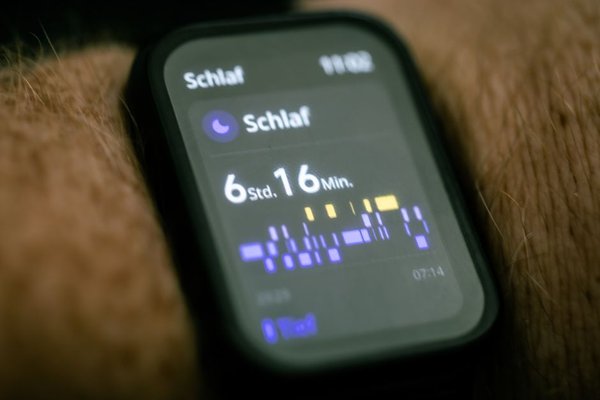
Your watch says you slept seven hours, spent 52 minutes in deep sleep, and woke up six times. It looks precise enough to be a laboratory report. Yet smartwatch sleep tracking is built around estimates, not a direct view of your brain while you sleep. Understanding that difference makes the information much more useful.
What a smartwatch actually measures overnight
Most watches combine movement and pulse-related signals. An accelerometer detects changes in wrist position and motion. An optical heart-rate sensor shines light into the skin and measures reflected light to estimate blood-volume changes, a method called photoplethysmography. Depending on the model, the software may also consider heart-rate variability, breathing-related patterns, skin temperature, or other available signals. Smartwatch heart rate monitoring explains the optical sensor in more detail.
Algorithms compare these measurements with patterns learned during development and testing. Long periods of limited movement accompanied by certain physiological changes may be classified as sleep. Changes across the night help the system estimate when you were awake or in different sleep stages.
This is indirect measurement. Unlike a clinical sleep study, a watch usually does not record the electrical activity of your brain, eye movements, and muscle activity needed to identify sleep stages directly.
How smartwatch sleep stages are estimated
Sleep naturally moves through non-rapid-eye-movement sleep and rapid-eye-movement sleep, usually called REM. Consumer apps often simplify the night into awake, light, deep, and REM categories. Those categories are helpful shorthand, but their boundaries are calculated by the watch.
Light sleep
Light sleep generally combines the earlier non-REM stages. Breathing and heart rate often slow as you settle into sleep, although patterns vary. Because quiet wakefulness can look similar from the wrist, light sleep estimates may be especially difficult to interpret minute by minute.
Deep sleep
Deep sleep corresponds broadly to the deepest non-REM stage, associated with slow brain waves. It often occurs more prominently earlier in the night. A watch does not see those brain waves, so its deep-sleep figure is an algorithmic prediction rather than a direct measurement.
REM sleep
REM sleep is associated with vivid dreaming and changing physiological activity. REM periods generally become longer later in the night. Pulse and movement patterns can provide clues, but they cannot confirm REM with the certainty of a properly scored sleep study.
Which sleep numbers deserve your attention?
Total sleep time and sleep schedule
Estimated total sleep time is often a practical starting point. A watch can show whether your nights routinely fall short of the time you intended to sleep. Bedtime and wake-time patterns can also reveal a weekend schedule that shifts considerably from weekdays.
Still, time in bed and time asleep are different. If you lie very still while reading, your device may count some of that period as sleep. If you wake briefly and turn over, it may record an awakening that you never remember.
Awakenings and sleep efficiency
Some apps display time awake after falling asleep and sleep efficiency, the proportion of time in bed estimated to be spent sleeping. These numbers can be useful for spotting broad changes, but quiet wakefulness is a known weakness of wrist-based tracking.
How accurate is smartwatch sleep tracking?
Sleep tracking accuracy depends on the device, its software, the person wearing it, and the measurement being compared. Watches are often better at detecting that someone is asleep than at noticing every period of wakefulness or correctly naming each sleep stage.
A 2025 meta-analysis covering 24 studies found meaningful differences between consumer wrist trackers and polysomnography, the laboratory reference method, for measurements including total sleep time and time awake after sleep onset. Results varied across devices and studies. Another 2025 validation study of six wearables found that sleep detection was generally stronger than wake detection.
That does not make every night of tracking worthless. It means a chart showing exactly 43 minutes of REM should not be treated as proof that you experienced precisely 43 minutes. Comparisons over several weeks, using the same device under similar conditions, are usually more sensible than judging a single stage reading.
A better way to use your nightly report
Imagine your watch marks Tuesday as a poor night because deep sleep was low, yet you felt alert all morning. On Wednesday it gives a high score, but you spent the afternoon exhausted. Neither result should automatically outweigh your experience. A sleep score compresses many estimates into one number; it does not measure how rested you feel.
Try a two-week experiment instead. Wear the watch consistently, record roughly when you went to bed, and note morning energy in a few words. Look for repeated connections between bedtime, estimated duration, and how you function the next day. This approach gives you a clearer question to investigate than chasing a perfect score. A sleep tracking setup guide can help check the settings beforehand.
How to improve the quality of the readings
Wear the device snugly but comfortably, following the manufacturer’s guidance. A loose band may disrupt optical readings, while an overly tight band can be uncomfortable. Keep the sensor area clean, update the watch software, and check that sleep tracking is enabled.
Charge your device before bed rather than midway through the night. Check whether your model requires a sleep schedule, sleep mode, or several nights of baseline data before certain features appear. If battery life limits overnight use, smartwatch battery life tips may help you plan charging around your routine.
When the watch cannot answer the question
A consumer sleep chart cannot determine why you are exhausted, diagnose insomnia, or reliably rule out sleep apnea. Some specific wearable features may have regulatory authorization for narrow uses, but that does not turn their general sleep-stage reports into diagnostic tests.
Speak with a qualified healthcare professional if you regularly struggle to stay awake, have persistent sleep problems, or experience loud snoring, breathing pauses, or gasping during sleep. Share your symptom history; watch trends can be supporting context rather than the main evidence.
Frequently asked questions
Can a smartwatch tell when I enter deep sleep?
It can estimate deep sleep from wrist signals and learned patterns. It cannot directly identify the slow brain waves that define deep sleep in a clinical recording.
Why does my watch show sleep when I was awake?
Lying still produces movement patterns similar to sleep. Even with pulse information, quiet wakefulness can be mistaken for light sleep.
Should I worry about one night with little REM sleep?
Not on the basis of one wearable reading. Stage estimates vary, and normal sleep changes from night to night. Persistent symptoms matter more than an isolated graph.
Is a dedicated sleep tracker more accurate than a smartwatch?
Not automatically. Accuracy varies by model, algorithm, and metric. Look for independent comparisons with laboratory sleep studies instead of assuming that a specialist label guarantees better measurements.
What the data is really good for
Smartwatch sleep tracking works best as a long-term mirror of your habits. It can highlight irregular schedules and suggest patterns worth exploring, while remaining imperfect at identifying brief awakenings and exact sleep stages. Use trends alongside how you feel, and let persistent concerns lead to professional advice rather than another night of staring at a score.